The Weight of Everything You Own: How Your Stuff Is Quietly Running Your Life
Let's be real about something: most people who call themselves minimalists are not actually minimalists. They're people who own slightly less stuff than they used to, feel good about it, and still have a storage unit somewhere in the greater Phoenix area holding furniture they haven't looked at in three years.
This is not a judgment. It's a diagnosis. Because the gap between wanting to own less and actually owning less is one of the most underestimated psychological battles in the nomadic life — and nobody talks about it honestly enough.
Your stuff is not just stuff. It never was. And until you understand what it actually represents, you'll keep dragging versions of it with you no matter how many times you downsize.
Minimalism Is a Mindset Problem, Not a Storage Problem
The minimalism industrial complex — and yes, there is one, complete with matching linen aesthetics and $40 bamboo toothbrush holders — wants you to believe that owning less is primarily a practical problem. Get the right bins. Follow the right system. Watch the right documentary. Donate the clothes you haven't worn in a year.
That stuff helps. But it doesn't touch the actual root.
The real issue is that we use objects to tell ourselves who we are. Your guitar that you haven't played since 2019 isn't just taking up space — it's holding a version of yourself you're not ready to let go of. The person who plays guitar. The person who was going to play guitar. The person who bought that guitar during a specific summer that felt like the beginning of something.
Getting rid of the guitar isn't just decluttering. It's grieving an identity. And most people, when they realize that, quietly put the guitar back in its case and ship it to their parents' basement.
The Sunk Cost Trap That Nomads Fall Into
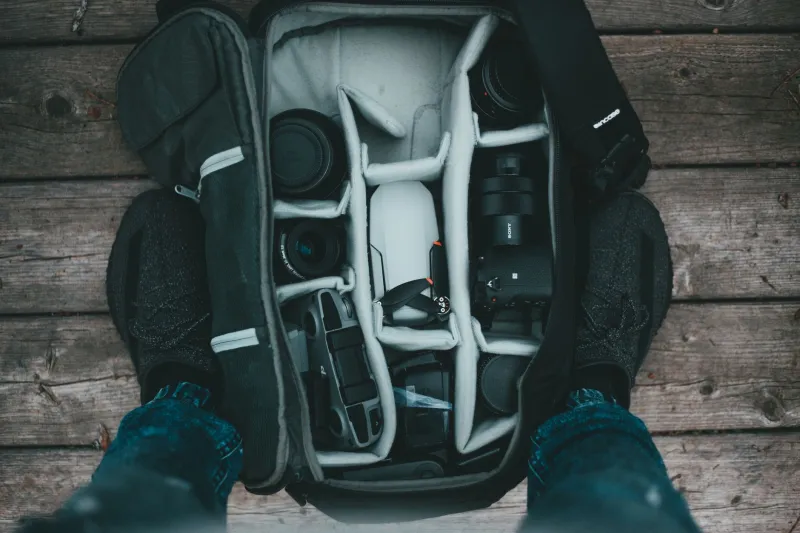
Here's where it gets specifically weird for travelers: we often accumulate travel stuff as a way of proving our nomadic identity to ourselves. The gear. The camera equipment. The elaborate first-aid kit. The four different packing cubes in four different sizes.
We bought it because we were going to be a certain kind of traveler, and now it lives in our bag as evidence of that intention — even when the reality of how we actually travel looks nothing like what we imagined.
This is the sunk cost fallacy in its most personal form. You spent $300 on a camera you never use, so you keep hauling it across state lines because getting rid of it would mean admitting the $300 is gone. Meanwhile, it weighs 2.4 pounds. It takes up a third of your bag. And every time you see it, you feel a low-level guilt about not using it.
The $300 is already gone. It was gone the moment you spent it. The question isn't whether you wasted the money — it's whether you want to keep paying for that mistake with your freedom.
The Difference Between Meaningful and Sentimental
Not everything should go. This is where a lot of minimalism advice goes wrong — it treats sentimentality as a weakness to overcome rather than information worth listening to.
The real skill is learning to distinguish between objects that are genuinely meaningful and objects that are anchors in disguise.
A genuinely meaningful object is one that connects you to something living — a relationship that still exists, a value you're actively practicing, a memory you want to keep accessible because it informs who you are right now. These things earn their weight.
An anchor-in-disguise is an object that connects you to a past version of yourself that you're holding onto out of fear rather than love. The fear that if you let go of the object, you'll lose the memory. The fear that letting go means the experience didn't matter. The fear that you're erasing something.
Here's the truth: your memories do not live in your things. They live in you. And the experiences that genuinely shaped you are not going anywhere, regardless of what you do with the physical artifacts.
A Framework That Actually Works
Forget the "haven't used it in a year" rule. It's too blunt. Instead, try asking three questions about any object you're considering holding onto:
One: Does this serve who I am right now, or who I was? Not who you hope to become, not who you used to be — who you actually are, living the life you're actually living, today.
Two: If I lost this tomorrow, would I replace it? Not could you replace it — would you? If the honest answer is no, that tells you something important about how much you actually need it.
Three: Am I keeping this for me, or for the story I tell about myself? This one is the hardest and the most useful. A lot of what we carry is costume. Props in the performance of a self we want others — or ourselves — to see.
If an object fails all three of those questions, it's an anchor. Let it go.
The Lightness on the Other Side
There's a specific kind of freedom that only shows up when you've gone through this process honestly. Not the theoretical freedom of minimalism Pinterest boards, but the actual physical and psychological sensation of moving through the world with only what you genuinely need and genuinely love.
Your bag gets lighter. Your decisions get simpler. You stop managing inventory and start managing experience. You spend less time thinking about your stuff and more time thinking about where you're going and why.
And here's the unexpected thing: the memories don't fade. The version of yourself that played guitar, or was going to play guitar, or bought the guitar during that summer — they don't disappear when the object does. They settle into you more quietly, more permanently, because they're no longer outsourced to a physical thing that needs to be packed, moved, and worried about.
Owning less isn't about deprivation. It's about finally trusting yourself to hold your own history without needing to carry proof of it everywhere you go.
That's the whole game. Everything else is just packing.